Interview: How ‘Woodstakes’ is Vampires vs Classic Rock
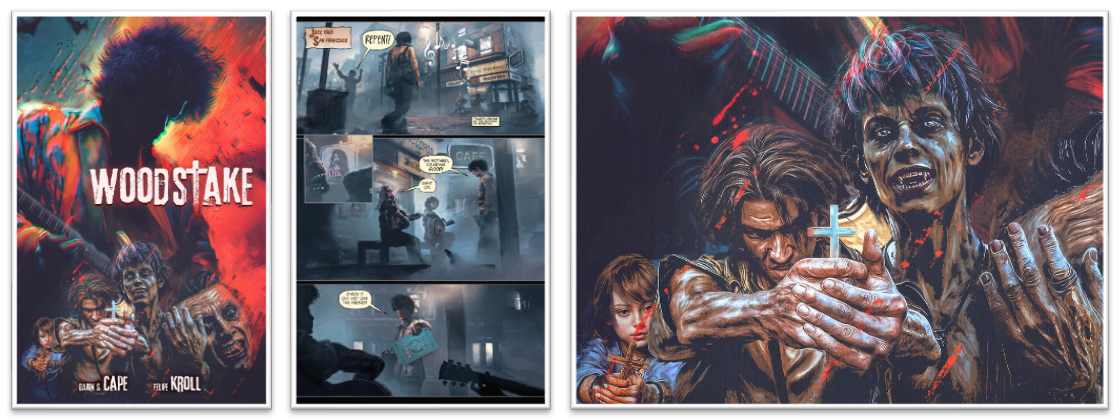
A blood-soaked mashup of vampire myth, rock history, and the counterculture of the late 1960s…
“I admire the 1960s generation… but ultimately we cannot escape human nature. This is something the vampire knows all too well.”
A mash-up of horror comics, supernatural thrillers, and music history, the hippie vampire comic book Woodstake (SHP Comics) is a wickedly clever spin on the Dracula legend—reimagined against the backdrop of the iconic Woodstock festival of 1969. Written by Darin S. Cape, with art from Felipe Kroll, Woodstake is a pulse-pounding genre thrill ride with a biting cultural commentary. The comic blends gothic horror, and dark humor, with striking, evocative artwork.
The new trade collection Woodstake: Three Days of Peace, Music and Blood comes out in April 2026. Monster Complex® talks to writer Cape about what inspired him to focus on the classic rock music festival, and to share with us his own favorite vampire stories. He also shares with us a surprising list of literary inspirations…
About Woodstake: Three Days of Peace, Music and Blood
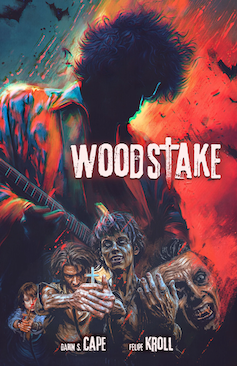
When a vampire descends on the summer of love, a generation of hippies is forced to survive three days of peace, music, and blood in this darkly funny, genre-bending thrill ride. A razor-sharp blend of satire, horror, and 1960s nostalgia, Woodstake delivers a character-driven narrative paired with a bold visual style that brings the late ’60s to life, complete with period-authentic detail, psychedelic flair, and sharp dark humor.
Sample the comic free online at AIPT: Free Comic Friday: Woodstake #0
Buy the original comic mini-series digitally on Global Comix
Interview: Darin S. Cape on Woodstake
#1) Darin, when writing this story, which direction did you look at this from? (Is this a “vampire story” that happens to be at Woodstock, or a “Woodstock story” that happens to have vampires?)
This is a vampire story set at Woodstock. I wouldn’t say, “happens to be at Woodstock,” because Woodstock was part of the concept from the beginning. But, in order for the humor and the satire to work, the vampire story had to be effective, otherwise, I was afraid it would just be campy.
I am a lifelong fan of Bram Stoker’s novel, especially in terms of how the vampire learns and manipulates the rules of Victorian society. The novel begins with, of all things, a real estate transaction.
I love the idea of a vampire not being just a monster, but a very shrewd observer of society with a deep understanding of human nature, things you would acquire after living for hundreds of years. This type of character is the perfect way to satirize the naivety of the hippie generation.
That is not to say that my sentiments are with the vampire. I admire the 1960s generation striving for peace and love during the horrors of the Vietnam war, but ultimately we cannot escape human nature. This is something the vampire knows all too well.
#2) What inspired you to focus on Woodstock? (As opposed to some other event?) When you listen to music, are you normally a fan of Woodstock era artists? How much research did you have to do for this?
It had to be Woodstock because of the thematic collision of the summer of love and the cynical nihilism of the vampire. What is interesting now that I’m writing the conclusion, which takes place at Woodstock ’99, is that the festival was almost as cynical and nihilistic as the vampire.
As a child in the ’70s, I grew up on a steady diet of classic rock. We used to joke that you couldn’t drive more than 30 minutes in Rhode Island without getting the Led out at least once.
I did a lot of research for this book. All of the songs referenced happen at the correct time.
There was a lot of serendipity. At the climax of Saturday night, as the vampire is ascendent, Credence was playing Bad Moon Rising.
We watched the documentary over and over, using locations, and background characters as inspiration. I also had a map of the festival and wanted to make sure that characters had enough time to make it from one location to another. My idea was that aside from a few dead bodies, the events of the story could have realistically taken place.
#3) What are some of your favorite inspirations for vampire fiction?
As mentioned above, Bram Stoker is my favorite, but there are a lot of vampire stories that I love. There is something about vampires that makes them so adaptable to different genres and storylines.
Here is a quick, and by no means complete, list of some vampire favorites: Anne Rice’s Interview with the Vampire, Blade comic book and film, What We Do in the Shadows, The Lost Boys, Let the Right One In, and of course, Abbott and Costello Meet Frankenstein.
#4) Who are your inspirations as a writer? (Comics or otherwise)
Alan Moore is my favorite comic book writer (especially Watchmen). I love the silent clowns (especially Buster Keaton), Japanese cinema from the 1950s and 1960s, and Spaghetti Westerns. I have old-fashioned tastes in literature including Cervantes’ Don Quixote, Jane Austen’s Mansfield Park and Persuasion, George Elliot’s Middlemarch, Edith Wharton’s The House of Mirth, and Wallace Stegner’s Angle of Repose. My favorite horror film of late is Robert Eggers’ The Witch.
Sink your teeth into Woodstake, a brilliant horror/comedy about three days of peace, music, and blood…
Buy the book
GlobalComix (digital)
Bookshop.org (which also supports your local bookstore)
More about the Woodstake online
Exclusive: A “Saga of Desire, Fear, and Fangs” (Daily Dead)
An Interview with Shawn Hainsworth, Founder of SHP (Digital Pubbing)
More from Monster Complex




28 Striking Vampire Books—including horror, romance, and comedy
Abbott and Costello Meet Frankenstein: Behind the scenes of the classic
Horror trilogy Night Eaters: What makes these graphic novels so personal
How “Total Eclipse of the Heart” turns out to be a vampire love song
Exploring Lost Boys: Behind the Beloved Vampire Horror Comedy
What We Do in the Shadows: Behind the scenes of the original movie
Halloween Man creator Drew Edwards on “monsters and misfits” in mash-up
How the Grim Reaper almost killed rock band The Turtles in 1966
Monster Mash: 13 Movies Where Frankenstein Meets Dracula Meets Wolf Man
How the woman who wrote for Wonder Woman rethought the world of Sword & Sorcery. “I’ve been a fan of strong female characters and pulp and fantasy and all of that forever.”