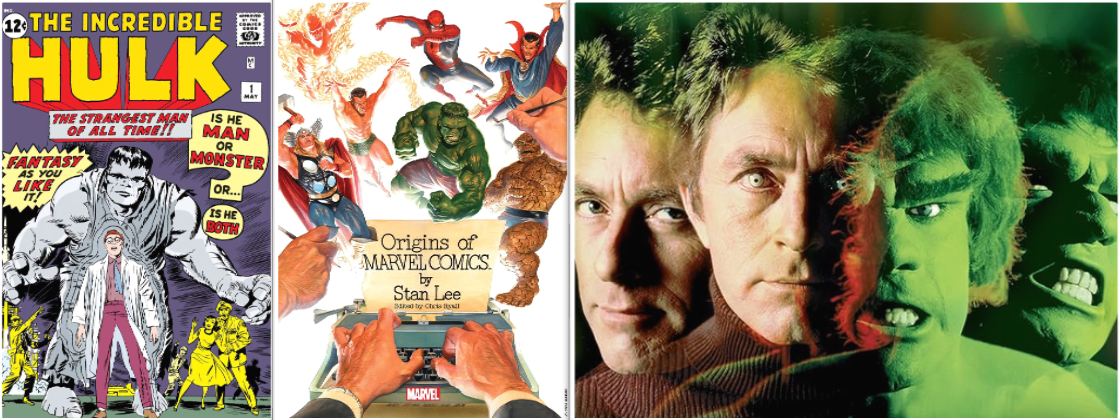
One of the earliest monster heroes, angry Dr. Banner transforms into musclebound green The Hulk...
“Mr. McGee—don’t make me angry. You wouldn’t like me when I’m angry.”
One of the most famous characters in the Marvel Comics library, The Incredible Hulk was also the inspiration for one of the greatest superhero TV shows ever made. The CBS TV show—which started off with a couple of TV movies—starred Bill Bixby as the human victim Dr. David Banner, Lou Ferrigno as monster The Hulk, and Jack Colvin as investigative reporter Jack McGee.
We’re sharing several YouTube videos that talk a lot about behind-the-scenes facts. But first, we’ll go over the historical context of The Hulk—in the comics as well as on the 1970s-1980s TV classic.
History of The Hulk (in comics)
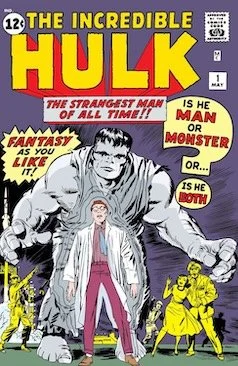
With the 1962 comic book debut of The Incredible Hulk #1, the idea of a monster superhero was still relatively rare. Now, he wasn’t the first “monster hero” for comic books. Some earlier examples include versions of Frankenstein’s Monster and 1940s swamp monster The Heap (which inspired the similar 1970s characters Swamp Thing and Man-Thing).
You can also make a case that Namor, the Sub-Mariner—who debuted in 1939 as an undersea mutant anti-hero—could be monstrous whenever he threatened the landlubbers. While Namor made his official debut in Marvel Comics #1, that comic was actually published by Timely Comics.
Over the years, Timely changed its company name at least a couple of times. And eventually became what we now call Marvel.
With the launch of the Marvel Comics brand in 1961, the first official comic book for their new approach was Fantastic Four #1 from creators Stan Lee and Jack Kirby. Which included a monster: The team’s Ben Grimm was the monster-ish orange rock creature codenamed The Thing.
Lee and Kirby took the monster-hero concept even further in 1962 with Incredible Hulk #1. When a science experiment goes wrong, meek scientist Bruce Banner is accidently overexposed to gamma rays. Soon he finds himself transforming into raging beast The Hulk. Soon, the two are switching back and forth.
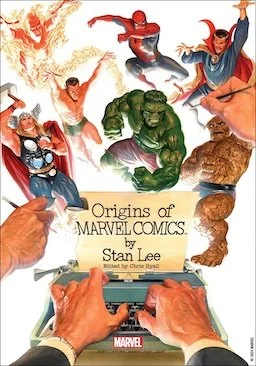
Writing an introduction for the Hulk reprint in Origins of Marvel Comics, Lee shared how the comic book was based on combination of Frankenstein’s monster and Dr. Jekyll and Mr. Hyde.
“For a long time,” he wrote, “I’d been aware of the fact that people were more likely to favor someone who was less than perfect.”
Lee mentioned how he always had a soft spot in his heart for the Frankenstein monster.
“No one could ever convince me that he was the bad guy. He never wanted to hurt anyone; he merely groped his torturous way through a second life trying to defend himself, trying to come to terms with those who sought to destroy him.”
He then talked how he also wanted to borrow from Jekyll and Hyde, too.
“Our protagonist would constantly change from his normal identity to his superhuman alter ego and back again.”
In his early years as a superhero, some of the rare traits of the Hulk monster were: how he was driven by rage issues; the way he and his human alternative, Bruce Banner, were two sides of the same person; and how his alternate identities depicted a particular Jekyll-and-Hyde transformation.
“Think of the challenge it would be to make a hero out of a monster,” Lee wrote. “We would have a protagonist with superhuman strength, but wouldn’t be all-wise, all-noble, all-infallibe.”
Over the decades since the Hulk’s first appearance, there have been multiple approaches from different creative teams. These alternate versions have included different personalities, and even different levels of mental abilities, for the monster.
But the classic model for Banner and The Hulk is that the two sides are essentially opposites of each other. One side is mentally strong but physically weak—while the other side is mentally weak but physically strong. In the comics, a regular feature is that each of the two personalities actually resents the other. They consider each other an enemy.
Now, the original comic book only lasted six issues before it was cancelled. (I know—what???) But the character quickly came back and became a major player in the Marvel universe. (And got a comic book again.)
Since his 1960s debut, The Hulk has appeared in all kinds of media and on all kinds of merch. This ranges from books and TV shows and movies and children’s books to clothes and games and even a theme park attraction.
One of the most famous adaptations was the live-action 1978 TV show The Incredible Hulk. Starring Bill Bixby and Lou Ferrigno as the two sides of the character(s), the show was a dramatic—and surprisingly realistic—approach for a comic book adaptation.
History of the Hulk on TV
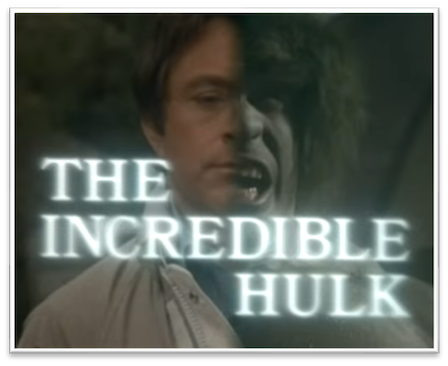
The 1977 pilot TV movie The Incredible Hulk established the origins of the situation. It also showed why Banner would feel forced to hide as a hitchhiker until he can cure his condition.
The TV approach to the comic book was developed by Kenneth Johnson. And, while fans generally want adaptations to follow the source material closely, Johnson brought some interesting changes to the concept. He wanted the show to work for the regular TV audience—even if they didn’t know anything about the comic books.
Which made the show more dramatic. And surprisingly more, well, realistic. As such, the monster’s strength level was more believable. And he didn’t speak—he growled like an animal.
The renamed character of David Banner was played by Bill Bixby, the producer’s first pick to play the Banner role. He had previously guested on lots of TV shows, plus starring in sci-fi sitcom My Favorite Martian (1963-1966) and father/son sitcom The Courtship of Eddie’s Father (1969-1972). He had also starred as a stage illusionist solving mysteries in The Magician (1973-1974).
The Hulk was played by bodybuilder Lou Ferrigno. Originally, actor Richard Kiel (The Spy Who Loved Me) had been hired to play the title monster, but when shooting the pilot movie, it was determined he was too skinny for the role. Kiel was replaced by the bulkier Ferrigno—but there’s still one early shot of Kiel in the role.
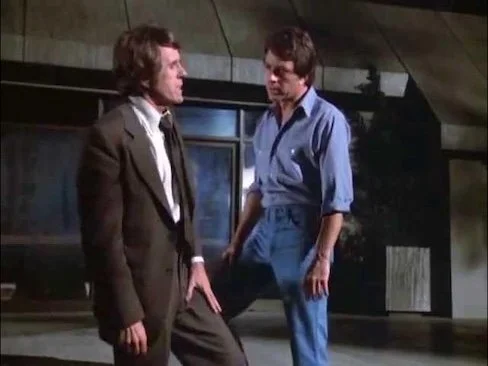
“Mr. McGee—don’t make me angry. You wouldn’t like me when I’m angry.”
Actor Jack Colvin played the third character in the triangle: Tabloid reporter Jack McGee. Throughout much of the series, he’s seeking to catch the The Hulk and prove his existence. Partly because he believed the Hulk is a threat—but also because he’s hoping to advance his career as a journalist.
The second TV movie was The Return of the Incredible Hulk (1977). This was followed by the historic 1978-1982 TV show The Incredible Hulk.
As mentioned, Johnson and his team would look for realistic angles for the man-vs-monster. Whenever something upset Banner, he’d eventually get angry enough that it triggered his transformation into the giant, green-skinned, muscle-bound monster. Like, if Banner was getting beat up, it helped that he turned into a giant thing that punched back. Hard.
However, some episodes offered examples where Banner’s transformation does not necessarily improve his situation. (And what a great musical score to emphasize that!)
Like that time David was sinking in quicksand….
Or when David had to land a Boeing 747—but didn’t know how to stop the plane…
(Seriously. If you’re a fan of The Hulk and haven’t watched this show, you need to.)
After the show ended, Bixby and Ferrigno returned to their roles for three reunion movies. While we can appreciate what they meant with these movies, they slipped a little more into the campiness of certain earlier comic book movies.
These Hulk reunion movies did include a couple of Marvel comics team-ups: 1988’s The Incredible Hulk Returns (including a version of Thor) and 1989’s The Trial of the Incredible Hulk (with Daredevil).
The final movie was 1990’s The Death of the Incredible Hulk. While the movie does offer an actual ending, it’s been said there were intentions to bring them back again. However, Bixby died of cancer before they could make any more.
Here are some YouTube videos sharing behind-the-scenes facts about the show…
15 Weird Facts about The Incredible Hulk You Didn’t Know (Remember When)
10 Things You Didn’t You Didn’t Know About Incredible Hulk TV Series (Minty Comedic Arts)
Incredible Hulk (1977): 15 Weird Facts You Definitely Missed (Back Before)
More videos:
WTF Happened to The Incredible Hulk? (1977-1982) (JoBlo Originals)
History of the Incredible Hulk TV Show (Tvcrazyman)
The History Of The Incredible Hulk TV Series (DoubleReelTV)
Find The Incredible Hulk online:

Marvel’s Incredible Hulk was the inspiration for one of the greatest superhero TV shows ever made. We’re sharing behind-the-scenes facts. But first, we’ll go over the historical context…